|
|
Roman
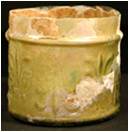
Mold-Blown Yellow-Green Glass Pyxis
Origin: Syria (Houran)
Circa: 50 AD to 200 AD
Dimensions: 2.16" (5.5cm) high
| Historic
Information
‘Transforming
the Skin’ Numerous facial preparation are recommended
in the ancient medical text, including a recipe for
‘transforming the skin – ‘take one
measure of warmed honey, one measure of natron, one
measure of northen salt, blend together and annoint.
Oils and Pefumes of Ancinet Egypt by Joann Fletcher
------
Special salt rations given early
Roman soldiers were known as "salarium argentum,"
the forerunner of the English word "salary."
Hippocrates, the Father of Medicine,
discovered the therapeutic qualities of seawater by
noticing the healing affects it had on the injured hands
of fishermen. The seawater not only restricted infection
risks, but patients who followed treatments involving
the use of seawater found that it also promoted pain
relief. It is now known that sea salt therapy is an
effective treatment that assists in the rejuvenation
of the cells and also induces a healthy exchange of
minerals and toxins between the blood and the water.
------
But such is the riot
and superfluitie of man, that being not content with
that perfection of Nature shining in those plants and
trees above rehearsed, he hath not ceased to mingle
and compound them, and so of them all together for to
make one confused smell: and thus were our sweet ointments
and precious perfumes devised
Among the most common unguents at the present day, and
for that reason supposed to be the most ancient, is
that composed of oil of myrtle, calamus, cypress, cyprus,
mastich, and pomegranate-rind. I am of opinion, however,
that the unguents which have been the most universally
adopted, are those which are compounded of the rose,
a flower that grows everywhere; and hence for a long
time the composition of oil of roses was of the most
simple nature, though more recently there have been
added omphacium, rose blossoms, cinnabar, calamus, honey,
sweet-rush, flour of salt or else alkanet, and wine.
The same is the case, too, with oil of saffron, to which
have been lately added cinnabar, alkanet, and wine;
and with oil of sampsuchum, with which omphacium and
calamus have been compounded. The best comes from Cyprus
and Mytilene, where sampsuchum abounds in large quantities.
The commoner kinds of oil, too, are mixed with those
of myrrh and laurel, to which are added sampsuchum,
lilies, fenugreek, myrrh, cassia, nard, sweet-rush,
and cinnamon.
------
Erika Ribechinia, ,
, Francesca Modugnoa, Maria Perla Colombinia and Richard
P. Evershedb
aDipartimento di Chimica e Chimica Industriale, University
of Pisa, Via Risorgimento 35, 56126 Pisa, Italy
bOrganic Geochemistry Unit, Bristol Biogeochemistry
Research Centre, School of Chemistry, University of
Bristol, Cantock's Close, Bristol BS8 1TS, UK
Received 24 October 2007;
revised 10 December 2007;
accepted 21 December 2007.
Available online 16 January 2008.
Abstract
A combination of gas chromatographic (GC) and mass spectrometric
(MS) techniques, including direct exposure-MS (DE-MS),
high-temperature GC–MS (HTGC–MS) and GC–MS
of neutral and acid fractions, was employed to study
the composition and recognise origin of the organic
materials used to manufacture balm residues surviving
in a series of glass unguentaria recovered from excavations
of a Roman villa (Villa B) in the ancient town of Oplontis
(Naples, Italy). DE-MS provided comprehensive ‘fingerprint’
information on the solvent soluble components of the
contents of the unguentaria, while GC–MS analyses
provided detailed molecular compositions, highlighting
the presence of a wide range of compound classes including
mid- and long-chain fatty acids, long-chain hydroxy-acids,
n-alkanols, alkandiols, n-alkanes, long-chain monoesters,
phytosterols and diterpenoid acids. Characteristic biomarkers
and their distributions indicate the presence of beeswax,
Pinaceae resin and another wax, as the main organic
constituents of all of the preparations examined. In
particular, the occurrence of phytosterols and long-chain
monoesters, in which the acyl moiety was not exclusively
palmitic acid, suggested the presence of a second waxy-lipid
constituent of plant origin. The results are consistent
with beeswax being used in the preparation of the cosmetics
preserved in the unguentaria, while the other lipids
are most likely the residue of some as yet unidentified
plant extract(s), possibly deriving from the cuticular
waxes of flowers and/or leaves. The composition of the
extracts are consistent with the ancient practices of
maceration and/or “enfleurage”, in which
lipid-based materials, such as beeswax, animal fat or
vegetables oils, were used to extract aromatic and fragrant
substances from resin, flowers, spices and scented wood,
in order to produce unguents and balms.
|